Bunker Preparedness in Europe: How Families Can Shelter Safely and Preserve Quality of Life Underground
A practical civilian guide to finding shelters, preparing for short and long stays, improving daily life in a bunker, and using Elysian bunker search and maps before a crisis.
Across Europe, civil-protection shelters are becoming part of public conversation again. Some countries, such as Switzerland and Finland, maintain extensive shelter systems, while others are reassessing their civil-defense infrastructure. But finding a bunker is only the first step. Families must also understand how to prepare, what to bring, how to live underground for short or extended periods, and how to protect physical and psychological health. This guide explains how to use Elysian bunker search and maps as part of a wider family survival plan.
For many European families, the word “bunker” still sounds distant, historical, or extreme.
But civil-protection shelters are no longer only a Cold War memory. Across Europe, governments are again discussing preparedness, emergency supplies, shelters, civil defense, and population protection. The European Commission has urged citizens to maintain at least 72 hours of emergency supplies for crises such as cyberattacks, natural disasters, geopolitical instability, and armed aggression.
Some countries already have strong shelter traditions. Switzerland maintains approximately nine million shelter places in around 370,000 private and public shelters, giving it more than full population coverage, although local gaps still exist. Finland has about 50,500 civil defence shelters with space for around 4.8 million people, most of them private reinforced-concrete shelters in buildings. Helsinki alone reports approximately 5,500 civil defence shelters with around 900,000 places, enough for residents and people moving through the city.
Other countries are now reassessing their position. Germany, for example, has been discussing major investment in civil protection and shelter capacity after years of reduced Cold War-era infrastructure.
For civilians, this does not mean panic.
It means preparation.
A bunker is not only a concrete space underground. In a real crisis, it becomes a temporary home, a family shelter, a psychological pressure chamber, a logistics problem, and a decision-making environment.
The question is not only: “Where is the nearest bunker?”
The real question is: “Can my family live there safely, calmly, and with dignity for as long as needed?”
Understand what a bunker is for
A bunker or civil-protection shelter is designed to reduce exposure to danger.
Depending on the country and the structure, shelters may protect civilians from air attacks, blast effects, debris, chemical or biological contamination, radioactive fallout, extreme weather, or other emergency conditions.
But not every underground space is a true bunker.
A basement, parking garage, metro station, tunnel, reinforced shelter, and official civil-defence bunker are not the same thing. Some may offer temporary protection from fragments or weather. Others may include ventilation, blast doors, toilets, emergency exits, filtration systems, and designated capacity.
The first rule is simple: know the difference before you need it.
In a crisis, families should follow official civil-protection instructions first. But families can also prepare in advance by mapping likely shelter points, understanding routes, and knowing what each location can realistically provide.
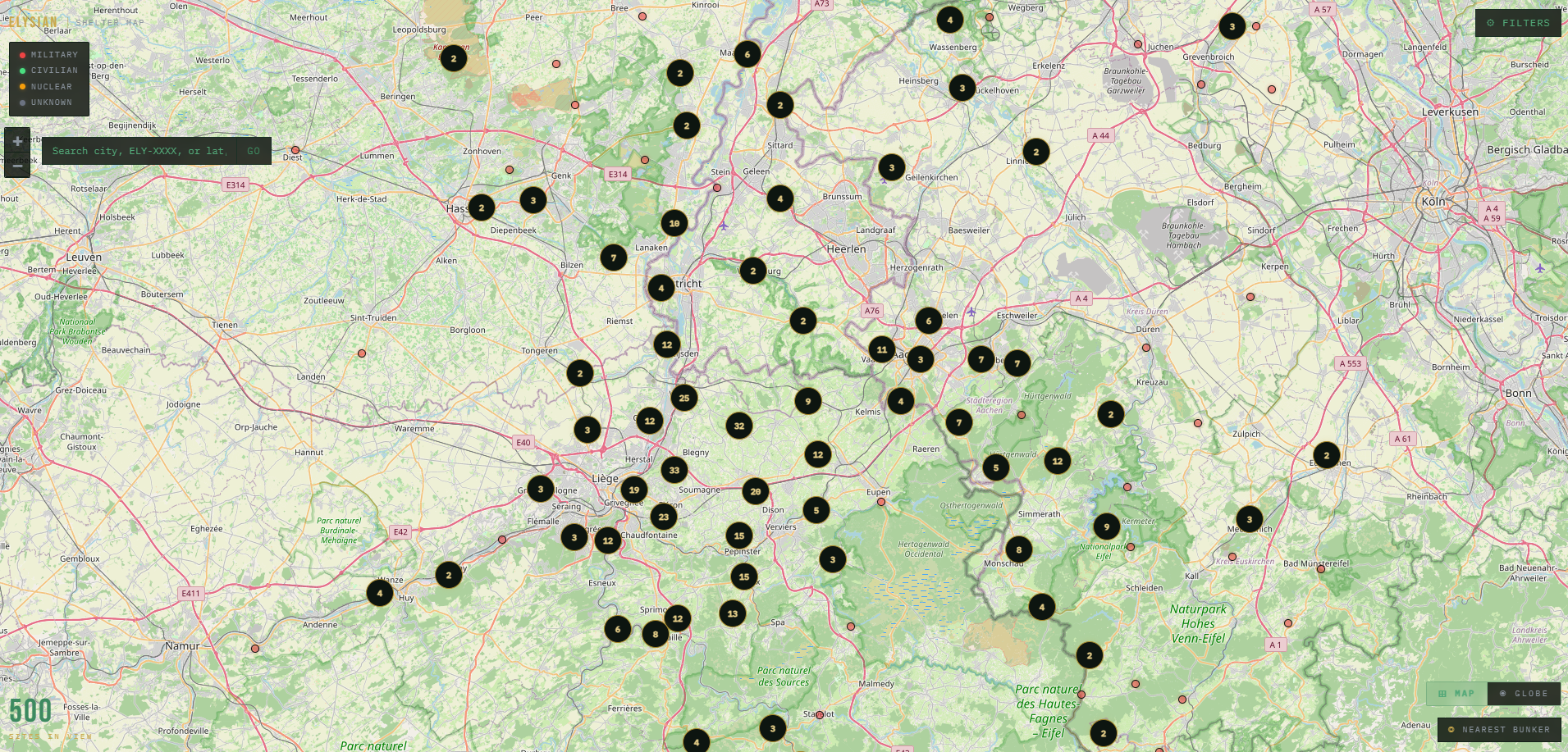
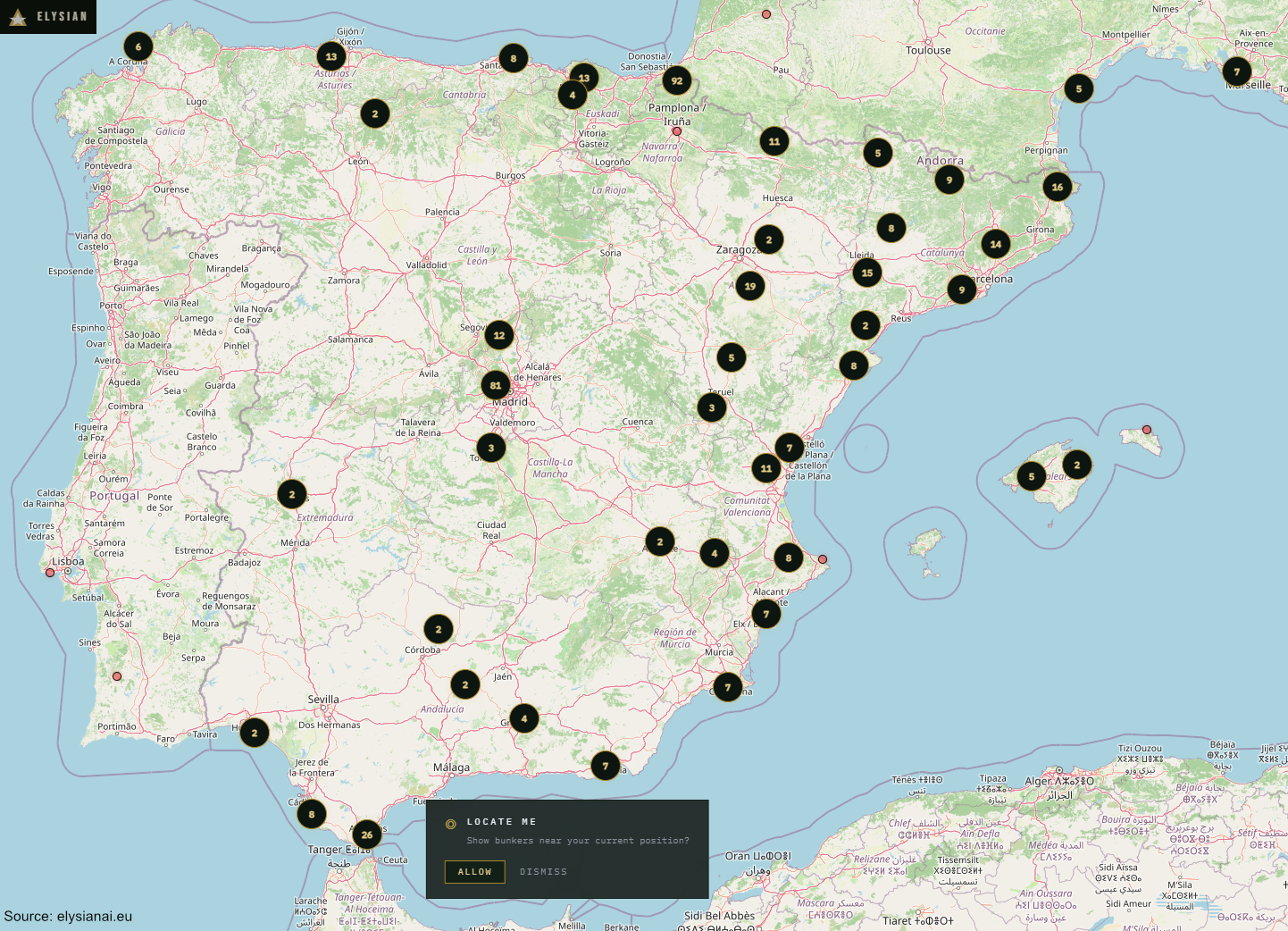
This is where the Elysian bunker search and maps become useful.
Use Elysian bunker search before the crisis
Bunker search is most valuable before panic begins.
During a real emergency, internet access may be unstable, mobile networks may be overloaded, power may fail, roads may close, and official information may change quickly. Waiting until the last minute to search for shelters is dangerous.
The Elysian bunker search and maps should be used as a preparation layer.
Families can use it to identify possible shelter locations near home, school, work, relatives, and common travel routes. The goal is not only to find one bunker, but to build a shelter network.
A family should know:
The nearest shelter to home The nearest shelter to work The nearest shelter to school Alternative shelters if the first option is full or inaccessible Walking routes to each shelter Driving routes, if roads remain open Public transport options, if available Nearby hospitals, pharmacies, police stations, and water points High-risk zones to avoid during movement
The map is not only about location. It is about decision-making.
A shelter that is close but across a bridge, tunnel, protest area, flood zone, or military target may be less useful than a shelter farther away with a safer route.
Elysian should be used to compare options, not blindly follow the nearest marker.
Build a personal bunker plan
Once your family identifies possible shelter locations, create a bunker plan.
This plan should answer five questions.
First: when do we go?
Define triggers. These may include official warnings, air alerts, nearby strikes, chemical risk, civil-protection orders, infrastructure collapse, or confirmed danger in your area.
Second: where do we go?
Choose a primary shelter and at least two alternatives.
Third: how do we get there?
Define walking and vehicle routes. Include nighttime routes and routes that avoid exposed areas, bridges, main avenues, government buildings, large crowds, and potential bottlenecks.
Fourth: what do we bring?
Prepare a bunker bag that supports both survival and quality of life.
Fifth: what do we do if separated?
Every family member should know meeting points, emergency contacts, and what to do if communication fails.
A bunker plan must be simple enough to execute under stress.
Prepare for short bunker stays
A short bunker stay may last a few hours or one night.
This can happen during an air alert, temporary attack risk, chemical warning, nearby explosion, severe unrest, or infrastructure danger.
For short stays, the priority is fast movement and basic comfort.
Your family should bring:
Documents Phone Power bank Water Snacks Medication Flashlight Warm layer Small first-aid kit Cash Keys Masks if appropriate Basic hygiene items Children’s comfort items Pet essentials if pets are allowed
The goal is not to bring your entire house. The goal is to move quickly and remain functional.
Short bunker use can still be stressful. The environment may be crowded, noisy, cold, humid, poorly lit, and emotionally intense. Children may cry. Older adults may feel trapped. People may argue. Information may be unclear.
A prepared family can reduce this pressure by arriving with water, power, documents, medication, and emotional structure.
Prepare for long periods underground
A long bunker stay is different.
If a family must remain sheltered for several days or longer, quality of life becomes survival.
The main challenges are air, water, sanitation, sleep, food, hygiene, privacy, boredom, fear, conflict, and uncertainty.
For longer stays, preparation should include:
More water Shelf-stable food Medication for extended use Sanitation supplies Waste bags Soap and disinfectant Toilet paper Menstrual products Baby supplies Pet planning Sleeping mats or compact blankets Ear protection Eye masks Books, cards, notebooks, or offline activities Offline maps Printed family contacts Small repair kit Backup lighting Extra power banks Radio or offline information source
Food should be simple, familiar, and low-preparation. Choose items that do not require cooking, create little smell, and do not increase thirst.
Water must be protected. In a long shelter stay, drinking water is not only a supply. It is a rationing system.
Hygiene must be treated seriously. Poor hygiene in crowded underground spaces can create illness, stress, conflict, and loss of dignity.
Improve quality of life inside a bunker
Survival is not only biological.
If a family stays underground for a long period, quality of life directly affects decision-making, cooperation, and mental health.
The first improvement is organization.
Divide your space, even if it is small. Create zones for sleeping, eating, bags, hygiene, children’s activities, and waste. A disorganized shelter becomes stressful quickly.
The second improvement is routine.
Families need rhythm. Wake up, clean, eat, check information, rest, talk, organize supplies, and sleep at regular times if possible. Routine gives the brain a sense of control.
The third improvement is light discipline.
Use light carefully. Too much darkness increases anxiety. Too much artificial light at night damages sleep. Keep a small light source for children and a separate flashlight for practical tasks.
The fourth improvement is noise control.
Bunkers can be loud. People talk, cough, move bags, open doors, charge devices, cry, and react to news. Earplugs or headphones can help adults and children rest.
The fifth improvement is emotional privacy.
Even in a shared shelter, families need moments of quiet. A scarf, blanket, corner, or simple rule like “quiet time after dinner” can help preserve psychological stability.
The sixth improvement is meaningful activity.
Children need tasks. Adults need focus. Boredom increases fear.
Use cards, drawing, reading, language learning, journaling, prayer, stretching, quiet games, inventory checks, and route planning. These are not luxuries. They help people remain human under pressure.
Protect children underground
Children may experience a bunker as frightening, confusing, or unreal.
They may fear the darkness, sounds, strangers, closed space, or the anxiety of adults. Some children become silent. Others become hyperactive or emotional.
Parents should explain the situation simply:
“We are here because this is the safest place right now.” “We have a plan.” “We have water, food, and lights.” “You do not need to solve this. Your job is to stay close and listen.”
Give children small responsibilities.
They can hold a flashlight, organize snacks, care for a toy, help count water bottles, draw a map, or keep their backpack ready.
Do not expose children to constant crisis news. Do not discuss worst-case scenarios in front of them. Do not let the bunker become only a place of fear.
For children, emotional safety is part of physical safety.
Manage family psychology in confined spaces
Bunkers create psychological pressure.
There may be lack of daylight, reduced privacy, uncertainty, bad air, uncomfortable sleep, limited movement, and fear about what is happening outside.
Families should expect stress reactions.
People may become irritable, silent, controlling, emotional, or impatient. This does not mean the family is failing. It means the environment is difficult.
To reduce conflict, assign roles.
One person monitors information. One person manages supplies. One person supports children. One person tracks medication and health. One person maintains contact with relatives if possible.
If the family is small, roles can rotate.
The most important rule is this: do not let fear become leadership.
Calm instructions are better than emotional reactions.
Sanitation and dignity
Sanitation is one of the most important bunker topics and one of the least discussed.
In short stays, discomfort may be manageable. In long stays, poor sanitation becomes dangerous.
Families should prepare hygiene kits with soap, sanitizer, wet wipes, toilet paper, menstrual products, diapers if needed, waste bags, toothbrushes, toothpaste, small towels, and basic disinfectant.
Keep waste sealed and separated from food and sleeping areas. Wash hands before eating. Keep children’s hygiene routines as normal as possible.
Dignity matters.
Clean hands, clean faces, dry socks, brushed teeth, and organized clothing can make a family feel less helpless.
In crisis, dignity is a survival tool.
What not to do in a bunker
Do not bring unnecessary heavy items that slow evacuation.
Do not rely only on your phone.
Do not assume the nearest shelter will be available.
Do not spread rumors.
Do not use open flames unless clearly permitted and safe.
Do not block entrances, ventilation, or emergency exits.
Do not separate from family members without a clear meeting point.
Do not consume all food and water early.
Do not ignore official instructions.
Do not treat the bunker as a permanent solution if the situation outside changes and safer evacuation becomes possible.
A bunker is protection, not a complete strategy.
Combine bunker maps with a wider survival plan
The Elysian bunker search and maps should be part of a complete family-protection system.
Finding a shelter is only one layer.
A full plan includes:
Home shelter-in-place preparation Bunker search and route planning Emergency bags Family communication protocol Evacuation destinations Document protection Medical preparation Children’s psychological support Supply planning Trusted information sources
The strongest plan gives your family options.
Stay home if it is safer. Move to a bunker if exposure increases. Evacuate if the area becomes unsustainable. Relocate if the crisis becomes long-term.
Preparedness is not about choosing one solution. It is about knowing when each solution is appropriate.
Final thought
Bunkers are returning to European public consciousness because the world has become less predictable.
But civilians should not think about bunkers with fear or fantasy.
A bunker is a tool.
Used well, it can protect life during the most dangerous moments of a crisis. Used poorly, it can become a crowded, stressful, disorganized space where fear spreads faster than information.
Families should prepare before the sirens, before the blackout, before the roads close, and before panic begins.
Use Elysian bunker search and maps to understand your options. Build routes. Prepare bags. Think about children, elderly relatives, pets, documents, medication, hygiene, and mental endurance.
The goal is not only to survive underground.
The goal is to remain organized, calm, dignified, and ready for the next decision.