Urban Survival: How to Stay Safe When a City Enters Crisis
Practical civilian survival strategies for blackouts, unrest, shortages, infrastructure failure, and emergency movement inside urban environments.
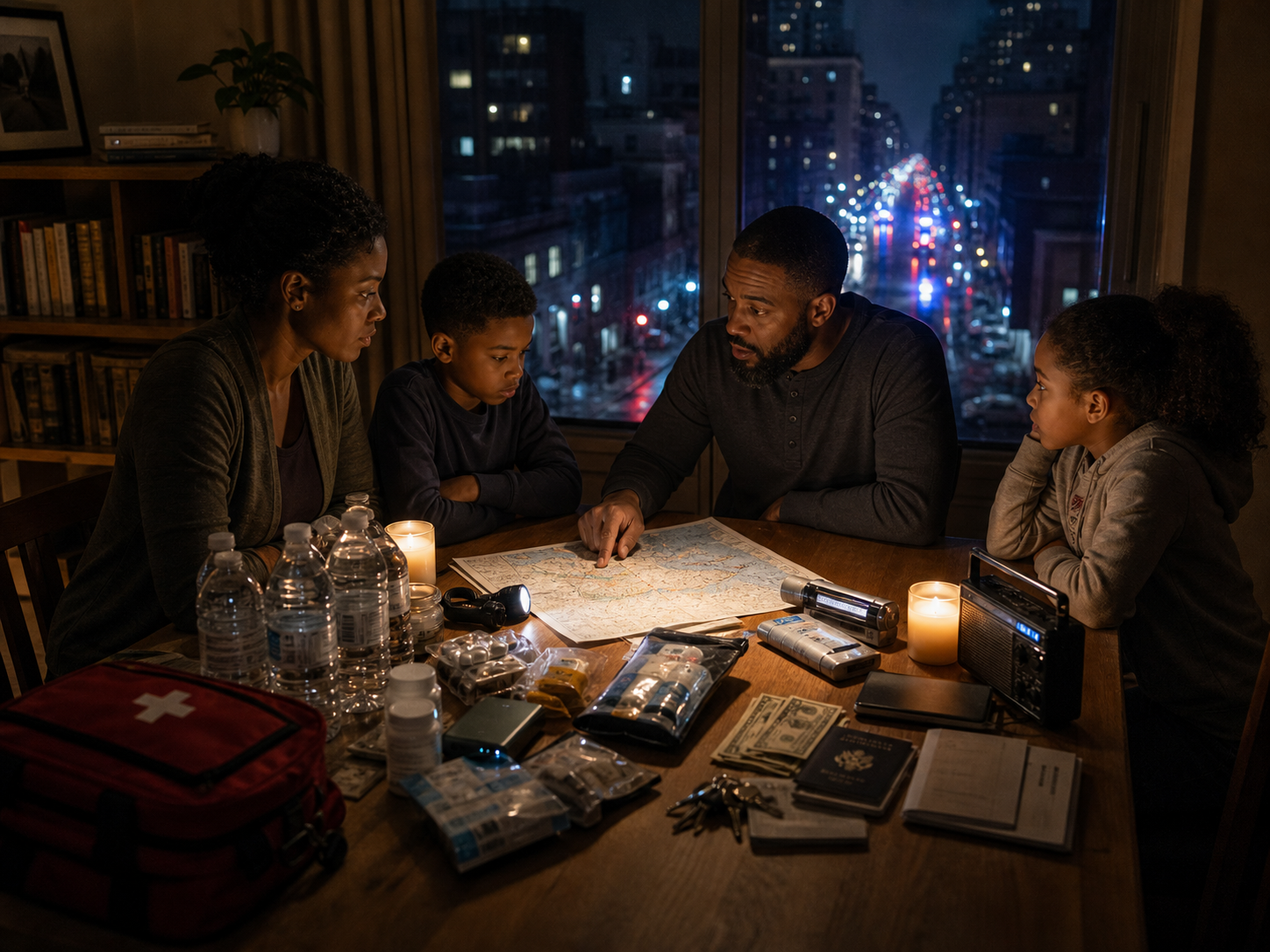
Cities offer access to services, transport, hospitals, and supplies — but during a crisis, they can also become fragile. When electricity fails, roads close, shops empty, or public order becomes unstable, families need a clear urban survival strategy. This article explains how civilians can prepare to stay safe, informed, mobile, and calm when a city enters crisis.
Urban Survival in Crisis: How Families Can Stay Safe Inside the City
Cities are powerful because they concentrate everything: people, transport, food distribution, hospitals, energy, information, police, schools, and work. But this concentration also creates vulnerability.
When a crisis hits a city, disruption spreads quickly.
A blackout affects elevators, payment systems, traffic lights, heating, mobile networks, and security systems. A transport strike can paralyze movement. Civil unrest can block neighborhoods. Flooding can make underground stations unusable. Cyberattacks can interrupt banking, logistics, hospitals, and communication. In wartime or major emergencies, cities can become difficult to navigate, supply, or evacuate.
Urban survival is not about escaping into the wilderness. For most families, the first challenge is surviving inside the city itself.
The objective is simple: reduce exposure, preserve mobility, maintain communication, and make decisions before panic takes over.
Know Your City Before It Fails
Most people only know one version of their city: the normal version.
They know their favorite routes, metro lines, shopping areas, school paths, and work commute. But in a crisis, the normal version disappears. Roads may close. Public transport may stop. Bridges, tunnels, stations, and main avenues may become blocked. Some areas may become unsafe because of crowds, flooding, fire, police activity, or infrastructure damage.
A prepared family studies the city before disruption.
Know at least three ways to leave your neighborhood. Know how to walk home from work or school if transport stops. Identify hospitals, police stations, pharmacies, public shelters, water points, parks, open spaces, and high-risk areas.
Avoid depending only on GPS. Download offline maps and keep a printed map at home or in your car. Mark safe routes, meeting points, and alternative exits.
In a city crisis, navigation is survival.
Build a Shelter-in-Place Plan
In many urban emergencies, staying home is safer than going outside.
If streets are unstable, air quality is poor, violence is nearby, or authorities advise people to stay indoors, your home becomes your first protective zone.
A good shelter-in-place plan includes:
- Water
- Food
- Light
- Communication
- Hygiene
- Security
Store drinking water for every family member. Keep food that does not require refrigeration or cooking. Have flashlights, batteries, power banks, a radio, basic first aid, hygiene supplies, and essential medication. Keep some cash, because digital payments may fail.
Choose the safest room in your home. Ideally, it should be away from street-facing windows and easy to access. If there is unrest, smoke, broken glass, or danger outside, move family members away from exposed areas.
Urban homes are not bunkers, but they can become temporary safe zones if prepared properly.
Prepare for Vertical Problems
City residents often forget that buildings create specific risks.
If you live in an apartment, a blackout may disable elevators, garage doors, intercoms, heating systems, water pumps, and electronic locks. If you live on a high floor, carrying water, supplies, children, pets, or elderly relatives becomes much harder.
Prepare for this reality.
Keep water at home. Keep a flashlight near your bed. Know how to manually open building doors if possible. Learn the stair routes. Do not let your phone be the only source of light. Keep shoes accessible in case you need to move through broken glass or dark stairwells.
If someone in your household has mobility issues, plan early. In a city crisis, waiting until the elevator stops may be too late.
Control Movement Outside
During an urban crisis, movement should be intentional.
Do not go outside just to observe. Do not approach crowds, fires, police lines, damaged buildings, or flooded streets. Do not take children into unstable areas. Do not assume familiar places are safe simply because you know them.
Before leaving home, ask:
- Where exactly are we going?
- Why do we need to go now?
- What route will we take?
- What is our backup route?
- What happens if we cannot return?
Carry only what helps you move safely:
- Documents
- Water
- Phone
- Power bank
- Cash
- Keys
- Medication
- Weather protection
In the city, the wrong movement at the wrong time can create more danger than staying still.
Maintain Information Discipline
Cities generate noise during crises.
Sirens, rumors, social media posts, dramatic videos, group chats, conflicting reports, and panic messages can overload the mind. Bad information can push families into bad decisions.
Use trusted sources. Compare official alerts, local news, direct observation from a safe place, and messages from people you personally know.
Do not forward unverified warnings. Do not react to every viral video. Do not make decisions based on fear alone.
Information is useful only when it improves action.
Build Neighborhood Awareness
In urban survival, neighbors matter.
During a crisis, the first people available may not be police, firefighters, or emergency services. They may be the people in your building, street, or block.
Know who may need help:
- Elderly residents
- Families with babies
- People with disabilities
- People living alone
Know who has practical skills:
- Medical knowledge
- Tools
- Transport
- Languages
- Local contacts
Community does not replace preparation, but it multiplies resilience.
A prepared building is safer than an isolated apartment.
Final Thought
Urban survival is not about fear. It is about understanding how fragile daily life becomes when city systems stop working.
A prepared family knows how to stay inside safely, move outside carefully, communicate clearly, and adapt quickly.
In a crisis, the city changes.
Your plan must change faster.